
At a time when many financial institutions are shrinking their physical footprints, Credit Human Federal Credit Union ($4.5B, San Antonio, TX) has doubled down with a bigger, better headquarters building that lowers costs, reduces environmental impact, and reflects how the cooperative thinks about long-term wellbeing.
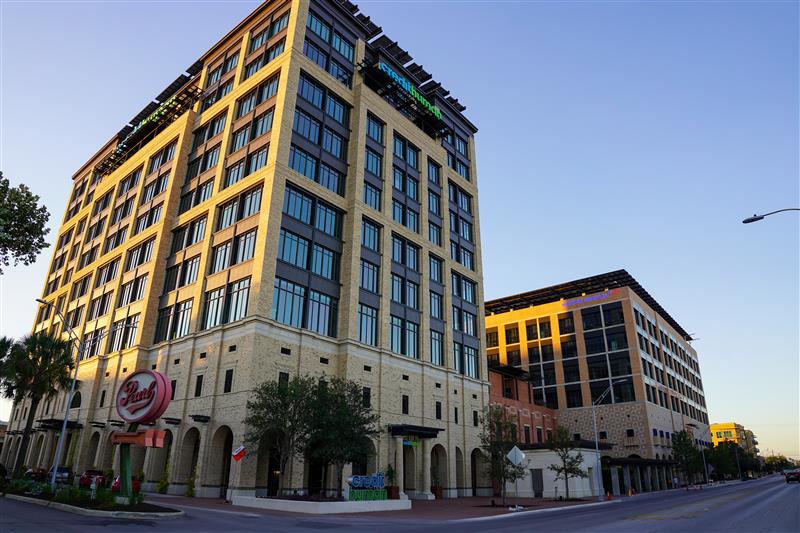
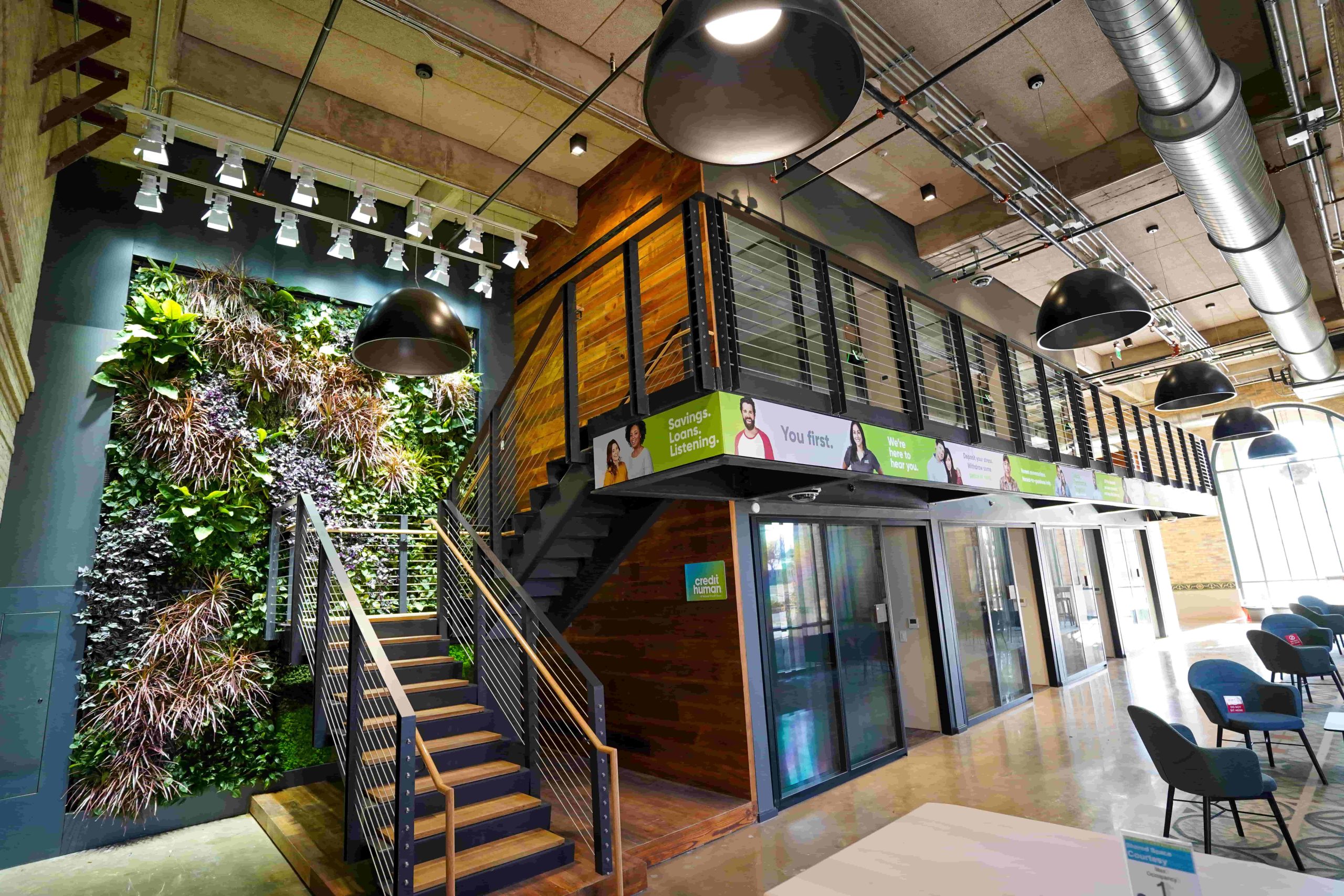
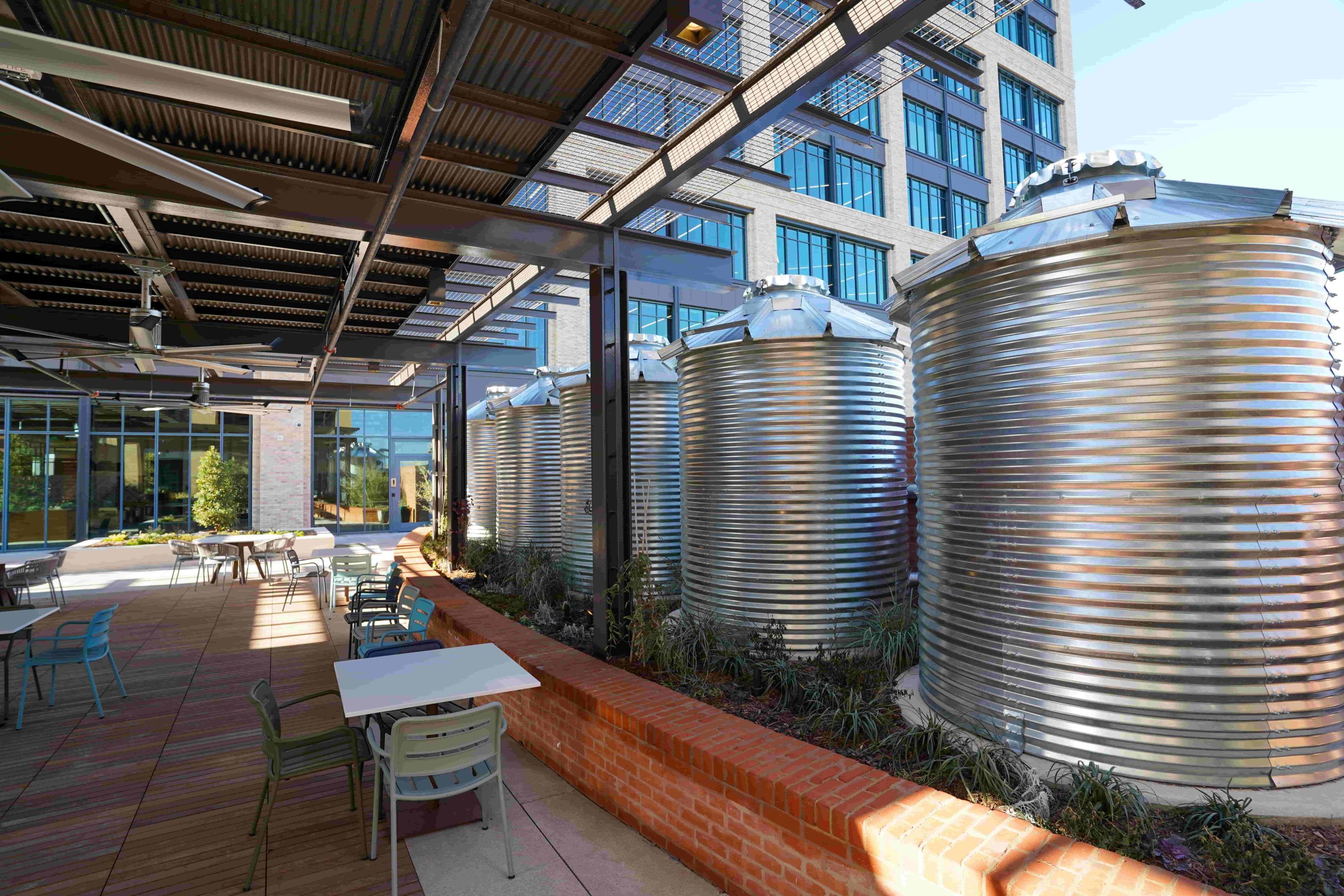
Completed in 2021, the Texas cooperative’s headquarters is a monument to modern sustainability, with water capture and reuse, solar panels, and geothermal energy. The three-acre property offers 52% more square feet of space than the old HQ at a 90% reduced utility cost, using roughly the same amount of water as two families of four. The building has drawn enough interest to warrant its own website, offering a behind-the-scenes look at its design and performance, and the credit union regularly hosts tours for stakeholders, students, and community groups interested in sustainable development.
Going Green From Construction To Culture
Sustainability is a key focus at Credit Human — the credit union has worked since 2019 to reduce its greenhouse gas emissions by 81% — yet the catalyst for the new HQ came down to operations.
Before moving into its current building, Credit Human operated two corporate offices in San Antonio. Leadership needed a unified footprint and additional space as the organization grew, turning their sights toward downtown. After a lengthy search, it selected a new address: 1703 Broadway.
That location, however, wasn’t just about square footage. Credit Human developed the building in partnership with Silver Ventures as part of a broader Class A office complex known as the Broadway Office Development. The site sits adjacent to Pearl, a 23-acre mixed-use redevelopment built on the former Pearl Brewery site just north of downtown San Antonio, one of the city’s most visible examples of urban revitalization.
Public-sector collaboration played a key role in bringing the project to life. The City of San Antonio and Bexar County provided financial support for infrastructure improvements, including upgraded intersections, expanded sidewalks and bike lanes, new green spaces, and a public parking garage. Credit Human also partnered with the San Antonio River Authority to incorporate low-impact development strategies that filter and manage stormwater runoff before it reaches the San Antonio River.

Although the building boasts cutting-edge features, leaders emphasize that its innovation lies in the way its systems work together.
“The majority of the technologies that we have in this building are 10 years old or more,” says Francisco Manon, senior manager of support services at Credit Human. “But making multiple building systems work together under one coordinated design hadn’t been done to this degree in the region.”
That level of integration introduced real-world friction during construction. Manon and his team navigated challenges with city inspectors who were unfamiliar with some of the interconnected systems, and the project — like nearly everything else at the time — faced pandemic-related supply chain delays.
Yet the greatest obstacle wasn’t technical. According to Beth Keel, sustainability programs manager, the real work was in getting stakeholders to think differently.
“The biggest challenge was a cultural change rather than technical,” she says. “We needed to help stakeholders move from thinking ‘we’ve always done it this way’ to asking what’s possible.”
One person already on board with the new approach was CEO Steve Hennigan.
“This is something our CEO started talking about six years before we started designing or selecting a property,” Manon says. “He wanted to do whatever was theoretically possible in this building.”

When it came time to move employees into the building, the organization adopted a deliberate onboarding process to teach employees how to operate in their new workspace, from sorting trash, composting, and recycling to eliminating single-use plastics and even removing vending machines and soda.
Keel continues pushing that cultural shift with ongoing education.
“I do lunch and learns every quarter,” she says. “We bring in partners like CPS Energy or SARA, the San Antonio River Authority, to educate our staff not only on greenhouse gas emissions but also what’s possible for their own homes and communities.”
Manon echoed that employee engagement is essential. Sustainability investments won’t perform as designed if the people using the building don’t participate.
Sustainability Is Good Financial Sense
Building And Performance Specs
- 90% reduction in utility costs.
- 140,000 gallons of water reuse storage.
- 40% of energy needs provided by solar.
- 100% of winter heat provided by 150 geothermal wells
Operating green isn’t just good for the environment, it can benefit the balance sheet, too. The same systems that reduce emissions also reduce operating costs, which creates a path for more investment.
“We have proved that not only is it good for the environment, but it makes financial sense,” Manon says. “We created a revolving fund and reinvest all the savings we produce with these kinds of investments into more projects.”
Manon ties the approach to measurable targets and long-term planning. For example, Credit Human has an organizational goal to reduce its emissions based on previous buildings up to 75% by 2030.
The financial framing also shows up in projects beyond its own headquarters.
“We’re installing solar arrays even in the new financial health centers, which normally are leased space,” he says. “We know we’re going to recoup that investment in six to seven years.” Looking ahead, Credit Human is in the design phase of a 100-year-old building in New Orleans, where the credit union believes it can target net zero despite the complexity of renovating a historic structure.
A Continued Ripple Effect
In addition to encouraging lifestyle changes among its staff, Credit Human has rolled out eco-friendly products for members.
The cooperative has a sustainable home lending program focused on geothermal, solar, water, and other home upgrades and has helped match homeowners with trusted companies, which leaders describe as a “high point” borrowers point to. As Credit Human invests in sustainability, leaders argue that members are poised to benefit.
Closer to home, the impact of the headquarters extends beyond its walls. Since opening, the Financial Health Center at 1703 Broadway has recorded increased foot traffic, new member accounts, and deposit growth as well as helped expand community partnerships. The building also includes a community room available free of charge to local nonprofits, reinforcing its role as a shared resource within a rapidly developing corridor.
Ultimately, Credit Human’s headquarters is an example of sustainability as an operational strategy rather than a marketing move. The building’s specs are impressive, but the team’s most significant insights for other credit unions are more about execution:
- Don’t cap ambition by designing to the minimum standard and build for integration.
- Plan for a culture change and invest in employee engagement.
- Frame the ROI like a long-term owner, not a short-term builder.